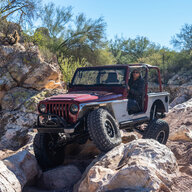
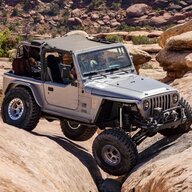
Let’s go on Pritchett. My view isn’t that it can’t be done without beadlocks aired down to 5psi. My view is that it makes it easier. Correct me if I’m wrong.

Let’s go snow wheelin. My view here is that snow is the climate you need the lowest psi.
Can one air down too much to where there is a loss of traction?
 
Can one air down too much to where there is a loss of traction?
It's a good question. I've wondered if there is a limit.

Logic says the more you air down the larger the tire patch. This can easily be tested.

The next question is whether that larger tire patch is effective on the terrain due to lack of pressure at really low pressures being exerted on the terrain and folding of the tread that gives no benefit and may be counterproductive. The tire has to be able to expand into the crack, crevice, formation, surface and hold to provide traction.
 
It's a good question. I've wondered if there is a limit.

Logic says the more you air down the larger the tire patch. This can easily be tested.

The next question is whether that larger tire patch is effective on the terrain due to lack of pressure at really low pressures being exerted on the terrain and folding of the tread that gives no benefit and may be counterproductive. The tire has to be able to expand into the crack, crevice, formation, surface and hold to provide traction.
There comes a point where the center of the patch starts to cup upwards and you are rolling on a donut rather than slice of bread. I haven't done this yet, but you can find it by stamping a sheet of cardboard with the tire at varying pressures. On 35s on a typical TJ, my understanding is that this occurs a little below 8psi. Meaning that 8psi is right about the lowest one should go, +/- a bit.

Something I have noticed on mine over a few sets of tires is that below 8psi the sidewalls get too squishy and there is a lot of lateral movement that I don't like.

Once I switch to 17s and install the Coyotes, I expect a few very interesting things to change with how the tire behaves at low pressures. Less sidewall makes for less lateral movement. And the internal beadlock only allows the tire to squish and deform so much. I expect an noticable increase in stability and tire predictability, especially while on hard off camber leans.

 
Here’s 5psi, contact patch looked right to me.

E5027E2A-4523-4528-B19F-C856E7496AE7.webp
 
I think you can air down too much for some terrain and hit a point where you get no return on lowering the air pressure more. And as has already been said you lose ground clearance as you lower your air pressure. How much is too much? I can't say for sure as I've played around with only running 3 PSI on snow runs and normally run 6-10 PSI on trails depending on the situation.

One of the reasons I'd gone to the Hummer rims was for the dual beadlock feature because I was burping the inner bead on some of the Rimrock trails.
 
  • Like
Reactions: JMT
Another curiosity I have noticed is that for years, my 8psi has often looked lower than those around me running the same tire and wheel size at 8psi. My couple of gauges and my Coyote Deflaters seem to agree with each other on my tires. So either other people's gauges are incorrect when they air down or...

Either way, it makes comparisons difficult.
 
15's are going away too, at least that SEEMS to be the trend. Two years ago on this forum 15's were always recommended. That has changed. As far as beadlock offerings, 15x8's are slim pickings. 17's tend to run in a 17x9 or 9.5. What affect does that wider rim have on tire bulge and contact patch? I'm probably into paralysis by analysis, but I do think I'm a few steps closer to deciding what to do than I was in January 2021 when I really started thinking about new wheels.

For those interested, here's where I have researched:

https://www.kmcwheels.com/wheels/performance
https://hutchinsoninc.com/rock-monster-wheels/
https://www.trbeadlocks.com (made in USA)

https://racelinewheels.com/collections/offroad-beadlock-wheels
https://www.omfperformance.com/truc...ock-conversion/automotive-beadlock-conversion
https://alliedwheel.com/collections/steel-beadlock
https://www.spyderlockwheel.com/sizes-specifications
https://www.innov8racing.com/beadlock
https://www.battlebornwheels.com/collections/beadlock
https://www.methodracewheels.com/collections/beadlock-wheels
https://walkerevansracing.com
https://www.coyoteents.com/wp-content/uploads/2014/08/BL_INSTALL_8PAGE-v3.pdf
 
IMO you want to be low enough for the tire to wrap around the rocks and other terrain sometimes. Having the tire wrap over & around a tree root can be helpful at times.

I don't know what pressure Larry is running in his tires.

IMGP2058.webp


IMGP2057.webp


And I'd put a little air back into my tires.

IMGP2140.webp
 
Another curiosity I have noticed is that for years, my 8psi has often looked lower than those around me running the same tire and wheel size at 8psi. My couple of gauges and my Coyote Deflaters seem to agree with each other on my tires. So either other people's gauges are incorrect when they air down or...

Either way, it makes comparisons difficult.
What effect does tire load really have on bulge and contact patch? Something that could only be tested with absolute confidence if one used the exact same tire and size with one in E and another in C or D. With different tires of the same size but different load one probably get relative and significant confidence because a 10-ply is a 10-ply, despite lesser incongruities.
 
Last edited:
There comes a point where the center of the patch starts to cup upwards and you are rolling on a donut rather than slice of bread. I haven't done this yet, but you can find it by stamping a sheet of cardboard with the tire at varying pressures. On 35s on a typical TJ, my understanding is that this occurs a little below 8psi. Meaning that 8psi is right about the lowest one should go, +/- a bit.

Something I have noticed on mine over a few sets of tires is that below 8psi the sidewalls get too squishy and there is a lot of lateral movement that I don't like.

Once I switch to 17s and install the Coyotes, I expect a few very interesting things to change with how the tire behaves at low pressures. Less sidewall makes for less lateral movement. And the internal beadlock only allows the tire to squish and deform so much. I expect an noticable increase in stability and tire predictability, especially while on hard off camber leans.

That about sums up the best option: Coyote. I agree. I have to get injury free to be able to do the install. That is a waiting and therapy game for me. The only drawback I see is if you are concerned about wheel damage deep in the dish you need some kind of rock ring to alleviate some of that. Larger ring, greater the protection. Best option for me seems to be to wait for now and go ahead with my welding projects when I can crawl under the rig without pain. In the meantime find some wheels I like in the size I want and get some Coyote's so they are on standby. I don't know if I have that patience, but this is the second or third time I've been convinced into Coyote's. 🤣
 
Last edited:
  • Like
Reactions: DrDmoney
I think the strength of the sidewall makes a difference in what pressure works best. As I understand it, a run flat tire just has a sidewall strong enough to hold up the weight of the vehicle at 0 air pressure. That's also why most of them have such a harsh ride.
 
  • Like
Reactions: Wildman and JMT
What effect does tire load really have on bulge and contact patch? Something that could only be tested with absolute confidence if one used the exact same tire and size with one in E and another in C or D. With different tires of the same size but different load one probably get relative and significant confidence because a 10-ply is a 10-ply, despite other incongruities.
In my experience and observations there are too many variables at play to simply point at load range and sidewall plies.
 
  • Like
Reactions: NashvilleTJ
Another curiosity I have noticed is that for years, my 8psi has often looked lower than those around me running the same tire and wheel size at 8psi. My couple of gauges and my Coyote Deflaters seem to agree with each other on my tires. So either other people's gauges are incorrect when they air down or...

Either way, it makes comparisons difficult.
Too many ammo cans
 
  • Like
Reactions: jjvw
Stamp it and see. Or run the same line multiple times at different psi to see if there is a difference in traction.
I was varying pressures on the trip to compare but I didn't get to run the same lines multiple times. It would be interesting to do. The day we ran Cliffhanger and Moab Rim I was at 6 psi and felt I had good traction.
 
  • Like
Reactions: DrDmoney and jjvw
Minor correction.

The 1k each forged wheels are made in the USA. The lower cost 500 ish wheels, the set I have, are made in china.

"The rim is formed overseas and we do the machining along with all beadlock ring manufacturing in house at our facility in Mount Vernon WA. We are the only FlowFormed extreme duty offroad wheel available."
 
I wanted Racelines, but they've gotten pricier. Plus, keep in mind that you'll chew up anything that sits on the outer lip. For this reason alone, I'm staying away from "Beadlook" wheels.

Currently, I'm eyeing these in a 17" wheel. I like the simplicity, style, and price. Here's one in a 15".

https://www.amazon.com/dp/B07QVY7C6T/?tag=wranglerorg-20
I'll think about those. I'm not too excited about gunmetal with a flame red TJ, but it is a nice suggestion. (noticed those are a 15x7.5")
 
Minor correction.

The 1k each forged wheels are made in the USA. The lower cost 500 ish wheels, the set I have, are made in china.

"The rim is formed overseas and we do the machining along with all beadlock ring manufacturing in house at our facility in Mount Vernon WA. We are the only FlowFormed extreme duty offroad wheel available."
Yep, they couldn't find anybody to do it in the US.
 
  • Sad
Reactions: Wildman