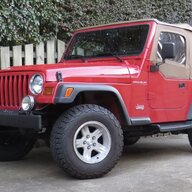
Tire pressure for 31s? Same width means same pressure?

Nothing to do with contact patch. It has to do with air volume. 17" wheel has less air volume than a 15" wheel of the same size tire and would need higher psi for the load capacity part.

That being said, load carrying capacity is only one of many factors that go into the recommended tire pressure for a specific vehicle. The general rule is don't go lower than the door placard but you may need to go higher if the load capacity requires it.

Just a few things besides load carrying capacity that tire pressure affects- rollover tendency, stability, spring rate, hydroplaning, steering, ride quality, tire heat buildup, etc etc. The engineers take this all into to account in addition to just the load carrying capacity.

You will notice most all vehicles have a tire pressure of at least mid 30's even though that load capacity far exceeds what is needed and that is not by accident.

Interesting stuff. So, if I run my 30x9.5 Load Range C tires at 29psi, how would I go about determining the proper pressure if I moved up to a 31.5x9.6 R17 tire?
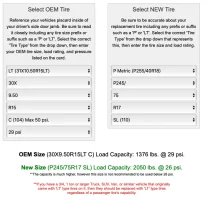
 
Just went back to the online tool and chose "P-Metric". Then I get 26psi. I need to go double-check the tires, but I do not think they are P245s, just 245s. Will confirm.

Edit: Confirmed, my new tires are 245/75/17, not P245/75/17.

Screen Shot 2021-12-23 at 12.57.01.png
 
Last edited:
Interesting stuff. So, if I run my 30x9.5 Load Range C tires at 29psi, how would I go about determining the proper pressure if I moved up to a 31.5x9.6 R17 tire?
Punch the new tire size in the calculator, if lower than 29psi, then use 29psi. If higher than 29psi, then use that higher number.

Or just do whatever you want, which is what most people do and probably won't make a difference. lol

If it is a P-metric tire and not LT, I can tell you that Jeep specifies 33psi for the factory P tires and I would probably go with that.

Once you start adding lift kits, changing out springs, shocks, bushings, etc, all the nuanced engineering goes out the window anyways and especially on a 20 year old vehicle...
 
So a 35x12.5 at 30 psi is going to have the same contact patch as a 30x9.5 at 30 psi.
Pretty sure this is incorrect, the larger and wider tire would have a larger contact patch even with the same PSI. only way to reduce the contact patch that much would be to overinflate by a large degree and 30psi won't do that as far as I've seen. You'd have to overinflate to the point that 3 inches of the width of the tire aren't touching the ground.
 
  • Like
Reactions: reddvltj
Nothing to do with contact patch. It has to do with air volume. 17" wheel has less air volume than a 15" wheel of the same size tire and would need higher psi for the load capacity part.

Goodyear Wrangler MTR w/ Kevlar
both load C
2403 for a 17, 2535 for a 15

so the correlation appears to hold, but through what mechanism does air volume impact the load rating?

I would have expected the load rating and associated inflation pressure to be connected to the sidewall deflection that could be tolerated at speed without overheating it...which would be correlated to the size of the contact patch and the height of the sidewall (a shorter sidewall has to deflect more for the same deflection in tread and would require more pressure and a reduced contact patch vs a taller sidewall tire).
 
Pretty sure this is incorrect, the larger and wider tire would have a larger contact patch even with the same PSI. only way to reduce the contact patch that much would be to overinflate by a large degree and 30psi won't do that as far as I've seen. You'd have to overinflate to the point that 3 inches of the width of the tire aren't touching the ground.

if you can make the physics work out for that, I'll concede. But I don't know how to make the force on top of the contact patch be different than the one underneath it under steady state conditions.
 
if you can make the physics work out for that, I'll concede. But I don't know how to make the force on top of the contact patch be different than the one underneath it under steady state conditions.
I'm not a physics expert, but a taller tire has a longer contact patch due to the bigger radius of the tire, a wider tire has a wider contact patch due to being, well, wider... the only way to reduce that significantly is to over pressurize the tire to the point that the surface of the tire becomes rounded even with the weight of the vehicle on it. Experience tells me that even at 40 psi I don't have 25% (3" on my 12.5" wide tires) of my tread width not contacting the road.
 
I'm not a physics expert, but a taller tire has a longer contact patch due to the bigger radius of the tire, a wider tire has a wider contact patch due to being, well, wider... the only way to reduce that significantly is to over pressurize the tire to the point that the surface of the tire becomes rounded even with the weight of the vehicle on it. Experience tells me that even at 40 psi I don't have 25% (3" on my 12.5" wide tires) of my tread width not contacting the road.

I'm not talking about the width of the contact patch, I'm talking about it's area. 1000 pounds with 30 pounds on each square inch is 33 square inches. It may be 11x3 on one tire and 9x3.75 on another. Still 33 in^2.
 
Generally speaking on a radial tire, the tire pressure has little effect the width that is in contact with the ground but moreso the length from front to back.

Notice my tires after the tire shop inflated to 35 psi. I normally run 25 or so.
D6196A00-47A4-4E09-8D09-60453A1D6FBF.webp
 
I think I see what you're getting at now, but I still think it's not right (would love someone to correct me if wrong)... but the PSI inside the tire (pressure of the gas filling the tire) I don't believe is an equal or 1:1 relation to the PSI measuring force between the tire and the road.

Evidence to me would be that your tires PSI doesn't change if you jack it up off the ground, nothing touching the ground so zero PSI there and vehicle weight has no bearing, yet the tires PSI remains constant.
Pressure is force over area

So corner weight divided by contact patch area

The tire pressure just affects contact patch area
 
I usually run my 30 x 9.5 tires at 29 psi on my stock-light 97 SE. That’s what the sticker in the door jam tells me to do.

I’m going to mount some 31.5 x 9.6 tires (245/75/R17). Since they are about the same width, I figure there will be about the same amount of tire in contact with the ground at the same tire pressure. Right? So I should stick with about 29 psi?

Edit: Very helpful answer from @freedom_in_4low, right here. Also a handy tool from @RMETeeJay right here, though I can't believe the result.
Just curious, but does the sticker on the door jamb tell you that the OEM tire size was 30x9.5R15?
 
ok. I'm not a tire expert but this is the way it breaks down in my head. If somebody with more expertise sees something wrong with this thought process, please speak up.

So let's say we have a 4000 pound Jeep with perfect weight distribution...1000lb/corner, and a certain area (the contact patch) of the tire in contact with the ground. In that contact patch and based on the first law of physics, you have 1000 pounds pushing up on the outside of the tire and 1000 pounds pushing down on the inside of the tire (we'll neglect the support provided by the sidewalls since it's really not significant as can be seen by how flatly it squishes when the tire is flat).

So that 1000lb pushing down on the inside of the tire is air pressure spread out over the area of the contact patch. So the higher the pressure, the smaller the contact patch and vice versa.

Now where size comes in, is that size of the tire does not change this. So a 35x12.5 at 30 psi is going to have the same contact patch as a 30x9.5 at 30 psi. The problem is that the size of contact patch for one is not appropriate for the other. To make the 35 have the same contact patch as the 30 means it's underloaded/overinflated, riding hard, not wearing evenly and probably helping your gas mileage by an amount that matters to the EPA but a real human will never notice. To make the 30 have the same contact patch as the 35 means it's overloaded/underinflated, riding way too comfortably :cool:, wearing unevenly and to the extreme may overheat and blow out on the interstate.

To into examples, let's take two pairs of tires of the same model where one has the width as the variable and one has the diameter.

BFG KO2
31x10.5R15 2270@50psi
33x10.5R15 2600@50psi

33x12.5R15 2205@35psi
35x12.5R15 2535@35psi

The fact that in each case, the larger tire has a larger load rating at the same pressure demonstrates that the larger tire is intended to have a larger contact patch, and to maintain the appropriate contact patch for the tire at the same load, the larger tire would take a lower pressure.
Physics aside (not a physicist), your assumption that the 2 different size tires will have the same contact patch at the same pressure is not accurate. They will (should) have the same % of overall tread in contact with the road given all things are equal. By all things I mean the tire to rim width differential is equal on each set. If you are using an 8" wheel on both sizes the wider tire is going to have far less percentage of tread surface in contact with the ground at higher pressures.

Also the tire's side wall does have a profound effect on a tires contact patch. A stiffer side wall does not need as much air pressure to carry a load. The more the side wall flexes the higher the pressure needed to maintain a uniform contact patch when driving on a smooth surface.

For the purposes that we use larger tires, (off road traction) most of the tires that we buy are designed to be run on narrower wheels than heavy duty load bearing designed tires are. If you put a 12.5 wide tire on a 10" rim vs an 8" rim you will notice you can maintain a good contact patch at max pressure with the 10" wide, but your tire starts to crown well below the max pressure reducing the contact patch (more so longitudinally than laterally) when on the 8".

As for the load capacities in your 2 examples, the are other factors at play besides tire dimensions. The tire casing of the tire along with the specified pressure and recommended rim width is what sets the load capability. Not the size of the tire.
 
I don't think that applies here.
The placard is for the factory recommended tire. We're talking about changing to a different size and type.
That is the recommendation from the Tire and Rim Association. The standardizing body in the US - tire placard or higher if required.

Been down this road before...forum people seem to think they know better than engineers that spend their entire careers on tires and wheels. That's why I said just do whatever makes you feel good.
 
Physics aside (not a physicist), your assumption that the 2 different size tires will have the same contact patch at the same pressure is not accurate. They will (should) have the same % of overall tread in contact with the road given all things are equal. By all things I mean the tire to rim width differential is equal on each set. If you are using an 8" wheel on both sizes the wider tire is going to have far less percentage of tread surface in contact with the ground at higher pressures.

Also the tire's side wall does have a profound effect on a tires contact patch. A stiffer side wall does not need as much air pressure to carry a load. The more the side wall flexes the higher the pressure needed to maintain a uniform contact patch when driving on a smooth surface.

For the purposes that we use larger tires, (off road traction) most of the tires that we buy are designed to be run on narrower wheels than heavy duty load bearing designed tires are. If you put a 12.5 wide tire on a 10" rim vs an 8" rim you will notice you can maintain a good contact patch at max pressure with the 10" wide, but your tire starts to crown well below the max pressure reducing the contact patch (more so longitudinally than laterally) when on the 8".

As for the load capacities in your 2 examples, the are other factors at play besides tire dimensions. The tire casing of the tire along with the specified pressure and recommended rim width is what sets the load capability. Not the size of the tire.

Helpful, thank you. So ... do you have any thoughts on the answer to my original question? Going from 30x9.5R15 to 245/75/17, and wondering how my pressure should change.
 
There is a fairly old way of determining what pressure you should run in any given tire for the "perfect" contact patch.

Once mounted and on the vehicle, get a tire marking chalk, and draw a line straight across the tread face.
(It is a trial and error method but it does work) on a flat surface drive the vehicle back and forth in a straight line across the chalk mark a few times and take note of where the chalk wears off first. If it wears off the center of the tread lower the pressure by a couple psi and start the test over. If it wears off the outer edges of the tread first add a couple psi and retest. The optimal pressure will wear the chalk mark evenly across the tread.
 
  • Like
Reactions: SSTJ and Apparition
There is a fairly old way of determining what pressure you should run in any given tire for the "perfect" contact patch.

Once mounted and on the vehicle, get a tire marking chalk, and draw a line straight across the tread face.
(It is a trial and error method but it does work) on a flat surface drive the vehicle back and forth in a straight line across the chalk mark a few times and take note of where the chalk wears off first. If it wears off the center of the tread lower the pressure by a couple psi and start the test over. If it wears off the outer edges of the tread first add a couple psi and retest. The optimal pressure will wear the chalk mark evenly across the tread.
Yep and the gravel dust in the picture I posted showed this 35 psi was too much so no gravel dust on the outer edges just the center. Hence why I ran closer to 25 on those tires.
 
  • Like
Reactions: reddvltj
Helpful, thank you. So ... do you have any thoughts on the answer to my original question? Going from 30x9.5R15 to 245/75/17, and wondering how my pressure should change.
Going back to @RMETeeJay 's post would be a good starting point. Keeping in mind exactly what the following image says at the bottom... If the tires you are looking at are "standard load" (aka passenger rated) then I wouldn't go any lower than 22. The method I described above will work for any tire and wheel combo.
1640279004428-png.webp