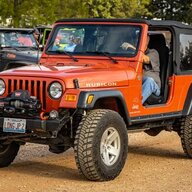
Tire pressure for 31s? Same width means same pressure?

Reading comprehension is hard for some people like you
Comprehension is the least of your issues. Ignorance on the other hand is right there at the top of the list.
You attempt to delegitimize information that others have offered, that are accurate, and then spew out BS about the specifications given by manufacturers on tire pressure recommendation. I proved your statement about minimum tire pressure wrong, get over it, you'll survive...
 
Comprehension is the least of your issues. Ignorance on the other hand is right there at the top of the list.
You attempt to delegitimize information that others have offered, that are accurate, and then spew out BS about the specifications given by manufacturers on tire pressure recommendation. I proved your statement about minimum tire pressure wrong, get over it, you'll survive...
Not sure making up something about 80 psi truck tires and higher pressure or whatever garbage you are spewing is proof but glad you showed me. You should be a prosecutor with your amazing proofing skills.
 
Not sure making up something about 80 psi truck tires and higher pressure or whatever garbage you are spewing is proof but glad you showed me. You should be a prosecutor with your amazing proofing skills.
Who's making things up??
Funny...they get their calculations from the Tire and Rim Association....the same guys that also say no lower than door placard pressure.
As I already stated my truck says 80 psi, and here's you reiterating the T&R Associations guideline.
So you say I should not go lower than that pressure.

I'll repeat myself, you are an IDIOT!

80psi is the MAX pressure of the tire and the pressure recommended by the Auto Manufacturer (for the OE tire size) for a truck loaded to it's full capacity.
 
  • Like
Reactions: DaveF
Who's making things up??

As I already stated my truck says 80 psi, and here's you reiterating the T&R Associations guideline.
So you say I should not go lower than that pressure.

I'll repeat myself, you are an IDIOT!

80psi is the MAX pressure of the tire and the pressure recommended by the Auto Manufacturer (for the OE tire size) for a truck loaded to it's full capacity.
Last I checked this is a Jeep forum. I don't know wtf truck you are even talking about. I would be happy to help you understand if you want to provide details of your truck.
 
Last I checked this is a Jeep forum. I don't know wtf truck you are even talking about. I would be happy to help you understand if you want to provide details of your truck.
Doesn’t much matter. My truck also says 80 psi and the first thing I did when it got delivered was drop the tire pressure because I didn’t have 22k lbs of gooseneck attached.
 
  • Like
Reactions: reddvltj
Last I checked this is a Jeep forum. I don't know wtf truck you are even talking about. I would be happy to help you understand if you want to provide details of your truck.
Jeep, Truck, Passenger car, it doesn't make a damn bit of difference, the information you offered is inaccurate, or more to the point idiotic!

(Note, this is just an example, because I'm not going outside in the blowing snow to take a picture to prove a point)

1640309232062.webp
 
Jeep, Truck, Passenger car, it doesn't make a damn bit of difference, the information you offered is inaccurate, or more to the point idiotic!

(Note, this is just an example, because I'm not going outside in the blowing snow to take a picture to prove a point)

View attachment 298128
For the rear-

Let's say you want to upsize to a 285-70-18? (not sure if that is a real size). The tire pressure calculator says the factory tire size max load at 80psi is 3196lb. It says you would only need 65psi to get 3196lb load capacity with the wider tire. You would still run 80psi with the new tires. Not 65psi from the load table because the recommendation is placard psi as a minimum, even though the wider tire can carry the same load at only 65 psi.
 
  • Face Palm
Reactions: reddvltj
I'm so glad I took my family to the theme park to ride roller coasters and see Christmas lights so I wasn't around for all this.

I haven't studied statics in 15 years so I'm completely open to my proposal being incorrect but nobody has provided anything more compelling.
 
For the rear-

Let's say you want to upsize to a 285-70-18? (not sure if that is a real size). The tire pressure calculator says the factory tire size max load at 80psi is 3196lb. It says you would only need 65psi to get 3196lb load capacity with the wider tire. You would still run 80psi with the new tires. Not 65psi from the load table because the recommendation is placard psi as a minimum, even though the wider tire can carry the same load at only 65 psi.
Actually, what I would do is the exact same thing I suggested the OP do to find the best contact patch for his new tire and wheel combination. I have done that with all of my vehicles and consistently get even tire wear and have never had an issue with blowing a tire due to excessive heat.

When it comes to changing tire sizes, especially when it comes to width, you throw out all "recommended" specs because you are no longer working within the parameters given by the manufacturer. When you go larger diameter and wider the casing (or carcass) of the tire is more important than the size when it comes to obtaining the optimum air pressure.

In the case of our Jeeps they are extremely light in comparison to the load handling capabilities of the tires we put on them so there is absolutely no basis in fact that remaining at the factory recommended pressures apply.
 
Actually, what I would do is the exact same thing I suggested the OP do to find the best contact patch for his new tire and wheel combination. I have done that with all of my vehicles and consistently get even tire wear and have never had an issue with blowing a tire due to excessive heat.

When it comes to changing tire sizes, especially when it comes to width, you throw out all "recommended" specs because you are no longer working within the parameters given by the manufacturer. When you go larger diameter and wider the casing (or carcass) of the tire is more important than the size when it comes to obtaining the optimum air pressure.

In the case of our Jeeps they are extremely light in comparison to the load handling capabilities of the tires we put on them so there is absolutely no basis in fact that remaining at the factory recommended pressures apply.
I get what you are saying. I am just explaining what is the recommended practice when changing tire size by TRA, Jeep, any legitimate tire store, etc. It doesn't hurt my feelings one bit if you or anyone else do it differently

However, I find it interesting for people to suggest using data from the TRA load/inflation tables, not knowing there are important notes that go along with those tables, and then getting all argumentative when that fact is brought up.
 
I'm so glad I took my family to the theme park to ride roller coasters and see Christmas lights so I wasn't around for all this.

I haven't studied statics in 15 years so I'm completely open to my proposal being incorrect but nobody has provided anything more compelling.
Like I said earlier, I have no clue as to the physics of it.
ok. I'm not a tire expert but this is the way it breaks down in my head. If somebody with more expertise sees something wrong with this thought process, please speak up.

So let's say we have a 4000 pound Jeep with perfect weight distribution...1000lb/corner, and a certain area (the contact patch) of the tire in contact with the ground. In that contact patch and based on the first law of physics, you have 1000 pounds pushing up on the outside of the tire and 1000 pounds pushing down on the inside of the tire (we'll neglect the support provided by the sidewalls since it's really not significant as can be seen by how flatly it squishes when the tire is flat).

So that 1000lb pushing down on the inside of the tire is air pressure spread out over the area of the contact patch. So the higher the pressure, the smaller the contact patch and vice versa.

Now where size comes in, is that size of the tire does not change this. So a 35x12.5 at 30 psi is going to have the same contact patch as a 30x9.5 at 30 psi. The problem is that the size of contact patch for one is not appropriate for the other. To make the 35 have the same contact patch as the 30 means it's underloaded/overinflated, riding hard, not wearing evenly and probably helping your gas mileage by an amount that matters to the EPA but a real human will never notice. To make the 30 have the same contact patch as the 35 means it's overloaded/underinflated, riding way too comfortably :cool:, wearing unevenly and to the extreme may overheat and blow out on the interstate.

To into examples, let's take two pairs of tires of the same model where one has the width as the variable and one has the diameter.

BFG KO2
31x10.5R15 2270@50psi
33x10.5R15 2600@50psi

33x12.5R15 2205@35psi
35x12.5R15 2535@35psi

The fact that in each case, the larger tire has a larger load rating at the same pressure demonstrates that the larger tire is intended to have a larger contact patch, and to maintain the appropriate contact patch for the tire at the same load, the larger tire would take a lower pressure.

After rereading this post I see where I misinterpreted what you were saying...

Particularly this: "So a 35x12.5 at 30 psi is going to have the same contact patch as a 30x9.5 at 30 psi."
If you are still utilizing an 8 inch wide wheel, then I can completely agree with this statement. However if you were using a 10" rim (not that most of us would do that for unless you're running double bead locks), 30 psi would be close to the right pressure to get the best contact patch.
 
Like I said earlier, I have no clue as to the physics of it.

After rereading this post I see where I misinterpreted what you were saying...

Particularly this: "So a 35x12.5 at 30 psi is going to have the same contact patch as a 30x9.5 at 30 psi."
If you are still utilizing an 8 inch wide wheel, then I can completely agree with this statement. However if you were using a 10" rim (not that most of us would do that for unless you're running double bead locks), 30 psi would be close to the right pressure to get the best contact patch.

I won't have the time to really delve into this article until at least Monday, but the data he uses comes straight from a tire manufacturer and probably sheds a lot of light on the issue...and a cursory glance suggests that my suggestion at least doesn't tell the whole story.

https://www.enginebasics.com/Chassi... contact_patch_area = weight / tire_pressure
 
I won't have the time to really delve into this article until at least Monday, but the data he uses comes straight from a tire manufacturer and probably sheds a lot of light on the issue...and a cursory glance suggests that my suggestion at least doesn't tell the whole story.

https://www.enginebasics.com/Chassi... contact_patch_area = weight / tire_pressure
I was looking at a Contact patch calculator and similar to your link, it leans towards low profile tires targeted at on road performance. I haven't messed around with the calculator at this point, but here's the link.

http://bndtechsource.ucoz.com/index/tire_data_calculator/0-20
 
  • Like
Reactions: Apparition
@Jerry Bransford , do you have any recommendations in reply to my OP?

I would also be interested to hear the right way to do a chalk test and not end up with under-inflated tires. I’ve read on other threads your warning of how few tires are designed to have an even contact with the road across the full width of the tire.
 
Ok for a comparison we have these 2 tires

1640316402056.webp
1640316421869.webp


Using a tire size calculator the exact metric equivalents are listed in the contact patch calculator

1640316318740.webp


2.2 bar is @ 32psi
1640316806640.webp


Note the contact patch differences
1640316253467.webp
 
  • Like
Reactions: SSTJ and Apparition
@Jerry Bransford , do you have any recommendations in reply to my OP?

I would also be interested to hear the right way to do a chalk test and not end up with under-inflated tires. I’ve read on other threads your warning of how few tires are designed to have an even contact with the road across the full width of the tire.
His 29 psi thought for the new tires still seems reasonable.

No thoughts of anything or any technique to make a chalk test accurate enough to use or trust.
 
I would also be interested to hear the right way to do a chalk test and not end up with under-inflated tires.
Keep in mind; when we talk about lowering pressure for ride quality or for any other reason, we're only talking about a few pounds. It's very subjective and most would never notice the difference in comfort or tire wear. Think about how most people were never concerned with the difference between summer and winter air pressure until cars got TPMS.
IMO, you're overthinking it.
 
@SSTJ You never mentioned what width wheels you will be running with the upsized tires. As long as the rim is the same width as the wheels you are running the 30x9.5x15 tires on a chalk test would likely work for your needs and not run any risk of being under inflated. Typically that becomes an issue only when much wider tires are put on narrow wheels.

Here are a few articles concerning this subject. They also cover some cautionary points.

https://www.intercotire.com/using_chalk_method_determining_psi
https://fourwheeltrends.com/what-is-the-chalk-test-for-tire-pressure/
https://www.4wheelparts.com/the-dirt/how-to-find-the-right-tire-pressure-for-your-4x4-using-chalk/
 
  • Like
Reactions: SSTJ
His 29 psi thought for the new tires still seems reasonable.

No thoughts of anything or any technique to make a chalk test accurate enough to use or trust.

Thanks Jerry.

When you say "his", do you mean mine? I'm the OP, but maybe you had someone else in mind?

So, if no chalk test, then the only real test to ensure the pressure is correct is to watch the treads for how they wear down? And they should wear down evenly, across the full width of the tire?