I've been waiting for this opportunity. 1 dollar for nude pics, 50 dollars to not post them.Maybe if we all pitch in to buy @mrblaine a cute top to go with his skirt he'd make us some videos.


I've been waiting for this opportunity. 1 dollar for nude pics, 50 dollars to not post them.Maybe if we all pitch in to buy @mrblaine a cute top to go with his skirt he'd make us some videos.

I think they did fantastic.I thought the whole point of the video(s) was a “cheap Jeep challenge”.
I think they both tried to keep it around 5k all in. With that said, I can certainly forgive some shortcuts and less-than-ideal suspension geometry. With regard to what their goal was; I’d say they both succeeded.

I've been waiting for this opportunity. 1 dollar for nude pics, 50 dollars to not post them.
I've been waiting for this opportunity. 1 dollar for nude pics, 50 dollars to not post them.
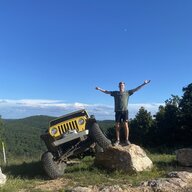
What are the qualities of good suspension geometry? What is happening in the rear that causes the front to behave that way? Why does the geometry matter so much in a situation like this climb, instead of just the wheelbase and center of mass?The light fronts are largely the result of what is happening in the rear. This is heavily dictated by the suspension geometry and the shocks.
It's as real as the pics I sent over he asked for.Fake dollar! Don't fall for it, Blaine!
What are the qualities of good suspension geometry? What is happening in the rear that causes the front to behave that way? Why does the geometry matter so much in a situation like this climb, instead of just the wheelbase and center of mass?
I'm fuzzy on the specific behaviors of leafs
We went wheeling with a YJ last weekend on leafs and it was excruciating to watch. At first I thought the guy was just a really bad, throttle heavy driver, but then I was told that with leaf springs you have to come into an obstacle with more momentum than you would on a TJ (not sure if that's true or not?) due to the suspension not wanting to articulate with leaf springs as easy as it would with coil springs.
Anyways, it was painful to watch and ultimately ended in the YJ running into a large rock and snapping the motor mount, which then ended up smashing the oil filter into the rock and spilling oil everywhere.
Line choice and a better driver. While not apples to apples; leafs, even when under the axle (spring under) can take on Johnson valley.We went wheeling with a YJ last weekend on leafs and it was excruciating to watch. At first I thought the guy was just a really bad, throttle heavy driver, but then I was told that with leaf springs you have to come into an obstacle with more momentum than you would on a TJ (not sure if that's true or not?) due to the suspension not wanting to articulate with leaf springs as easy as it would with coil springs.
Anyways, it was painful to watch and ultimately ended in the YJ running into a large rock and snapping the motor mount, which then ended up smashing the oil filter into the rock and spilling oil everywhere.
Your Dad was right on the mark with the idea of a progressive rate spring and more thin leafs...Honestly over the years it’s shown that the aftermarket is more in tune to manufacture the right progressive rate spring for off road type vehicles.My dad and I have discussed this somewhat. When he was building his cj5 in the 80s-90s, he paid a lot of attention to the leafs to make sure they were just enough to create the ride height without creating too thick of a leaf pack. This meant his CJ was often far more flexy than others allowing him to approach obstacles more slowly and carefully. Consequently, his softer leafs eventually led to axle wrap and a broken pinon.
Thanks, that makes more sense. Time to read up on antisquatI'm fuzzy on the specific behaviors of leafs, except that I see what I believe to be what looks like low antisquat. During a steep climb this will cause the rear to sink under drivetrain load. The weight shift from this sinking rear will make the front end lift. With linked suspension, the amount of antisquat can be tuned by moving the control arm mount locations.
The two extremes we usually see of bad suspension geometry on a steep climb are the sinking rear/light front described above usually from a lifted long arm, and a rising rear that leads to an uncontrollable hopping usually seen with lifted short arms. A preferable behavior is somewhere in the middle, where the rear doesn't sink or rise when under load. This is what we see in the Ultra 4 car that greatly contributes to it's stability and smoothness.

The antisquat is determined by the instant center. Understand how and why that is and you will be further along than most.Thanks, that makes more sense. Time to read up on antisquat
I'm fuzzy on the specific behaviors of leafs, except that I see what I believe to be what looks like low antisquat. During a steep climb this will cause the rear to sink under drivetrain load. The weight shift from this sinking rear will make the front end lift. With linked suspension, the amount of antisquat can be tuned by moving the control arm mount locations.
The two extremes we usually see of bad suspension geometry on a steep climb are the sinking rear/light front described above usually from a lifted long arm, and a rising rear that leads to an uncontrollable hopping usually seen with lifted short arms. A preferable behavior is somewhere in the middle, where the rear doesn't sink or rise when under load. This is what we see in the Ultra 4 car that greatly contributes to it's stability and smoothness.
I'm not convinced that radius arms have anything to do with the unloading. There is no front arm design that can control what the front is going to do. All one can do is try to control the weight shift by controlling how the rear behaves....Then you add in they are running a radius arm on the XJ which allows the front to unload the moment the Jeep goes vertical and you get the results shown.
...