
Yeah, honestly that link you posted is one the better deals I've seen with a battery. The batteries are really what I think I don't want to pay for.
Once you get a few, then they reproduce.


Yeah, honestly that link you posted is one the better deals I've seen with a battery. The batteries are really what I think I don't want to pay for.
I didn't get the 1/2" because I went to the junkyard with my friend a while back and he brought a Milwaukee 1/2" and it was just too big to be of any use. We pulled 2 engines and 1 trans in one day and it was useful probably 2-3x, while his 3/8 fit way more places.
Idk what model he had or if dewalts 1/2"s are smaller or blah blah.... Also I thought 450ft lbs would be more than enough but that's clearly a made up number lol
Yeah, the bigger ones can get pretty bulky.
This compact one is the second one I purchased. Didn’t necessarily need it, but just found a good deal on it. After going out and looking at it, I forgot the smaller one doesn’t have selectable settings and isn’t the XR. It’s been pretty handy though and I’m glad I got it. Like someone else said, once you have some batteries, the bare tool purchases aren’t too bad.
https://www.amazon.com/dp/B09HVXKJF6?tag=wranglerorg-20
View attachment 551338

Remembering which is which is confusing sometimes. I don’t know how new the Atomic line is as I just bought that one last year. The XR I’ve hade since 2018. I do think the XR is their top of the line version. I could be wrong though.
This is from the Dewalt website.
DEWALT 20V MAX is the next line after 18V, introducing lithium-ion batteries.
- Standard size
- Brushed motor
DEWALT 20V XR improved on the 20V MAX line by introducing brushless motors and high-capacity lithium-ion batteries.
- Enhanced components
- Compact
- Brushless motors
DEWALT 20V ATOMIC are designed to be compact and powerful for a wide range of applications.
- More compact size
- Light-weight
- Optimized for tight spaces, overhead work, and longer periods of use
- Brushless motor
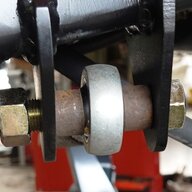
They are getting stuck on the radius transition between the hex and the bulge. Stop pushing so hard to force the socket against that transition and it slows down how much they get stuck. The other thing that does is stop you from smearing the lead threads in the lug nut and on the stud when you keep pushing while spinning after the nut is off.Ok cool not just me.
I need to hit the socket back and forth with a hammer to get it off... No concrete driveways haha and wobbling the gun with the socket still attached rarely is enough. Maybe that's one thing that you get faster at with experience tho
Not sure what you mean by hex and bulge?They are getting stuck on the radius transition between the hex and the bulge.
Stop pushing so hard to force the socket against that transition and it slows down how much they get stuck. The other thing that does is stop you from smearing the lead threads in the lug nut and on the stud when you keep pushing while spinning after the nut is off.
The problem with non specificity is that it leads to confusion. While timber screws could be called wood screws, they are not what you normally consider to be a wood screw. They are for timber framing, they are tough, hardened, and take a lot of horsepower to drive.Wood screws? Yeah I don't have any experience with yours specifically but if it has settings for wood screws I'd guess it doesn't have the beans I'd expect for mechanic work.
Maybe look up a picture of a fucking lug nut and at least try to figure it out.Not sure what you mean by hex and bulge?
That I can not fix although I am starting to agree with your assessment that perhaps power tools are not your thing.Seems like it is because I'm using the wrong size socket haha
Unless you found some hammered out in some 3rd world shithole by a small child with a rock and a dull chisel, they are exactly close enough to be interchangeable. 3/4" = .750, 19mm = .748My 19mm is probably just not close enough to 3/4" for those lugs
Tool bullshit aside, yes, that is exactly normal, by design. The main reason we use a countersunk tapered seat in the rim and a matching taper on the lugnut is to increase the contact area and the amount of friction it takes for the lug nut to come loose. Simple, easy, very effective.I can torque my wheel lugs to 90ft lbs with a torque wrench and then it can't break them free.
Is this normal?
The problem with non specificity is that it leads to confusion. While timber screws could be called wood screws, they are not what you normally consider to be a wood screw. They are for timber framing, they are tough, hardened, and take a lot of horsepower to drive.
https://jakesales.com/collections/1...YbGQZIq_IO4nsbWHsMpw3w9qebHvvITgaAk9MEALw_wcB
Unless you found some hammered out in some 3rd world shithole by a small child with a rock and a dull chisel, they are exactly close enough to be interchangeable. 3/4" = .750, 19mm = .748
Tool bullshit aside, yes, that is exactly normal, by design. The main reason we use a countersunk tapered seat in the rim and a matching taper on the lugnut is to increase the contact area and the amount of friction it takes for the lug nut to come loose. Simple, easy, very effective.
The problem with non specificity is that it leads to confusion. While timber screws could be called wood screws, they are not what you normally consider to be a wood screw. They are for timber framing, they are tough, hardened, and take a lot of horsepower to drive.
https://jakesales.com/collections/1...YbGQZIq_IO4nsbWHsMpw3w9qebHvvITgaAk9MEALw_wcB


