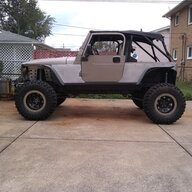
Good design vs bad design

I'm not convinced that radius arms have anything to do with the unloading. There is no front arm design that can control what the front is going to do. All one can do is try to control the weight shift by controlling how the rear behaves.

Radius arms have high antidive so just like high antisquat they will lift the chassis under torque.
 
  • Like
Reactions: Wildman
those XJ's cannot get weight on the front end at that incline angle. the white 1 in particular is out dropping his springs by a lot. i see several instance that spring drops off the stem and it's not even close to that steep of an angle. if they strapped that front end (or choked it with the winch) and held it from opening the suspension so much it could keep more weight/force down on the front end, resulting in a lower overall angle into or up the obstacle.

i appears it has to do with the setup. meaning how they split the travel allowed. once your past the 1/2 way point of that travel with the inability to keep weight on the front end, that spring is extending and your just bouncing off the top of it.

put your spring on the ground and push on it how much compression can you generate? now put it against the wall and push.....you can lean the weight onto a spring when loaded down onto, and keep it there.
you cannot keep force on it the horizontal spring because you have no weight to help. it's gonna be you push, it pushes back over and over and over.
now if you strap the spring and hold it against the wall you can limit the push back effect it's able to generate.
weight shift to the rear on a climb makes the front end to light to generate enough force for you collapse that spring and your never gonna get past that point.

so can you find a link setup or suspension sys that could not allow this to happen up front? can AS from the rear axle be transferred to the front axle in the form of AR (anti rise/lift). or is the solution less AD? a low front AD lets weight transfer occur more easily, no?

nothing scientific here just some fools observations.
 
those XJ's cannot get weight on the front end at that incline angle. the white 1 in particular is out dropping his springs by a lot. i see several instance that spring drops off the stem and it's not even close to that steep of an angle. if they strapped that front end (or choked it with the winch) and held it from opening the suspension so much it could keep more weight/force down on the front end, resulting in a lower overall angle into or up the obstacle.

i appears it has to do with the setup. meaning how they split the travel allowed. once your past the 1/2 way point of that travel with the inability to keep weight on the front end, that spring is extending and your just bouncing off the top of it.

put your spring on the ground and push on it how much compression can you generate? now put it against the wall and push.....you can lean the weight onto a spring when loaded down onto, and keep it there.
you cannot keep force on it the horizontal spring because you have no weight to help. it's gonna be you push, it pushes back over and over and over.
now if you strap the spring and hold it against the wall you can limit the push back effect it's able to generate.
weight shift to the rear on a climb makes the front end to light to generate enough force for you collapse that spring and your never gonna get past that point.

so can you find a link setup or suspension sys that could not allow this to happen up front? can AS from the rear axle be transferred to the front axle in the form of AR (anti rise/lift). or is the solution less AD? a low front AD lets weight transfer occur more easily, no?

nothing scientific here just some fools observations.

I disagree that the front suspension is somehow pushing the front end off the ground. Limiting droop would not change anything.
 
I disagree that the front suspension is somehow pushing the front end off the ground. Limiting droop would not change anything.
not off the ground................................ off the ability to compress the front spring
 
those XJ's cannot get weight on the front end at that incline angle. the white 1 in particular is out dropping his springs by a lot. i see several instance that spring drops off the stem and it's not even close to that steep of an angle. if they strapped that front end (or choked it with the winch) and held it from opening the suspension so much it could keep more weight/force down on the front end, resulting in a lower overall angle into or up the obstacle.

i appears it has to do with the setup. meaning how they split the travel allowed. once your past the 1/2 way point of that travel with the inability to keep weight on the front end, that spring is extending and your just bouncing off the top of it.

put your spring on the ground and push on it how much compression can you generate? now put it against the wall and push.....you can lean the weight onto a spring when loaded down onto, and keep it there.
you cannot keep force on it the horizontal spring because you have no weight to help. it's gonna be you push, it pushes back over and over and over.
now if you strap the spring and hold it against the wall you can limit the push back effect it's able to generate.
weight shift to the rear on a climb makes the front end to light to generate enough force for you collapse that spring and your never gonna get past that point.

so can you find a link setup or suspension sys that could not allow this to happen up front? can AS from the rear axle be transferred to the front axle in the form of AR (anti rise/lift). or is the solution less AD? a low front AD lets weight transfer occur more easily, no?

nothing scientific here just some fools observations.
I was waiting for him to lose a spring nearly did several times
 
not off the ground................................ off the ability to compress the front spring

The rig is doing a backwards somersault due to weight transfer. That is why the front gets light and the springs decompress. The front suspension geometry has nothing to do with it.
 
yes weight transfer which results in those front springs being to much force with no weight on them. bounce bounce bounce, flip.

if you can stop the bounce, can you generate a flop? only with the go pedal.
 
Last edited:
yes weight transfer which results in those front springs being to much force with no weight on them. bounce bounce bounce, flip.

Agreed. The front control arms are irrelevant to what is happening.
 
ok, so how do we combat this from the rear? the IC being inline will stack onto the rear axle a bit better and push rather than load up and hop.

i don't see any rear squat drawing the front up, i see the front not being able to settle down on the springs, due to this weight transfer. which just makes them pogo sticks at that point.

that white XJ never gets into them fully extended springs more than a couple inches during that climb b4 they are exhibiting symptoms of push off or bounce.
 
Last edited:
the more i watch the more that COG looks to be at play as well.
the buggy is the best climber. look at the relationship from chassis to wheel center. it doesn't use a big lift to provide wheel room, they use big wheels to get belly room. even though it drags some, it negotiates better then the rigs with more chassis to wheel center separation...........................so would this equate to where where the position of the pushing axle's IC is in a given instance vs the COG of the rig?
 
Last edited:
ok, so how do we combat this from the rear? the IC being inline will stack onto the rear axle a bit better and push rather than load up and hop.

i don't see any rear squat drawing the front up, i see the front not being able to settle down on the springs, due to this weight transfer. which just makes them pogo sticks at that point.

that white XJ never gets into them fully extended springs more than a couple inches during that climb b4 they are exhibiting symptoms of push off or bounce.

Not knowing what can be done with leafs, I might focus on good shocks and sway bars to better control the movements.
 
Line choice and a better driver. While not apples to apples; leafs, even when under the axle (spring under) can take on Johnson valley.

A smart driver with the right experience/seat time can make something that every other driver struggle with, look easy to crawl.

Remember even at The King of the Hammers this year, Jesse Haines race rig was on leaf springs on all four corners and sprung under the axle....he won the stock class and finished 19th overall at KOH after starting 122nd. Im sure most would look at that rig and say its a legacy setup and wouldnt bet money on it winning.View attachment 209753
Did you miss the portals somehow?
 
  • USA Proud
Reactions: Apparition
Isn't antidive a phenomena that occurs during braking?
Yes but it becomes antisquat when you are in four wheel drive and applying power. I know that all coil link suspensions will unload, but radius arms seem to unload much sooner and with what seems like more force. Part of that I am sure is due to wheelbase as my 76 F150 was not a big deal but my dads 65 Bronco was and they have basically the same suspension layout. Could it be the instant center and its relationship with the center of gravity since it is at the frame mount vs further back on the chassis with a 3 or four link? I know that if you run a radius arm in the rear (or a couple of the long arms that have the links share the same frame location) that they exhibit similar bad behavior. I also believe this was the problem people that ran the Nth Stinger were experiencing.
 
Yes but it becomes antisquat when you are in four wheel drive and applying power. I know that all coil link suspensions will unload, but radius arms seem to unload much sooner and with what seems like more force. Part of that I am sure is due to wheelbase as my 76 F150 was not a big deal but my dads 65 Bronco was and they have basically the same suspension layout. Could it be the instant center and its relationship with the center of gravity since it is at the frame mount vs further back on the chassis with a 3 or four link? I know that if you run a radius arm in the rear (or a couple of the long arms that have the links share the same frame location) that they exhibit similar bad behavior. I also believe this was the problem people that ran the Nth Stinger were experiencing.

I have a hard time seeing how antidive becomes antisquat unless one were to drive backwards.

I maintain my assertion that the front end is only along for the ride. And that the lightness we see in the front is really coming from what is occurring in the rear as a result of weight transfer.